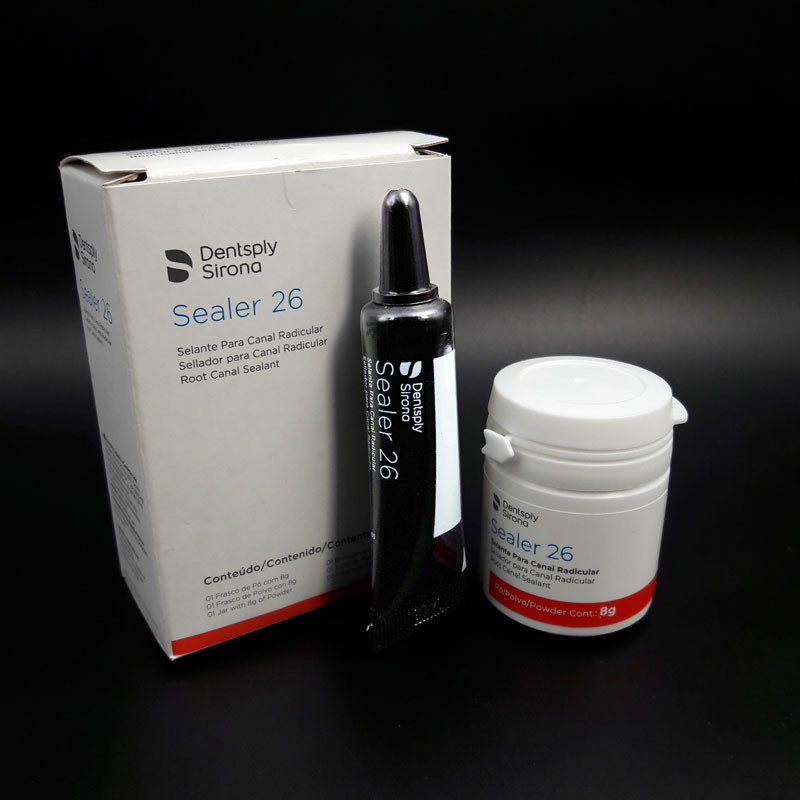
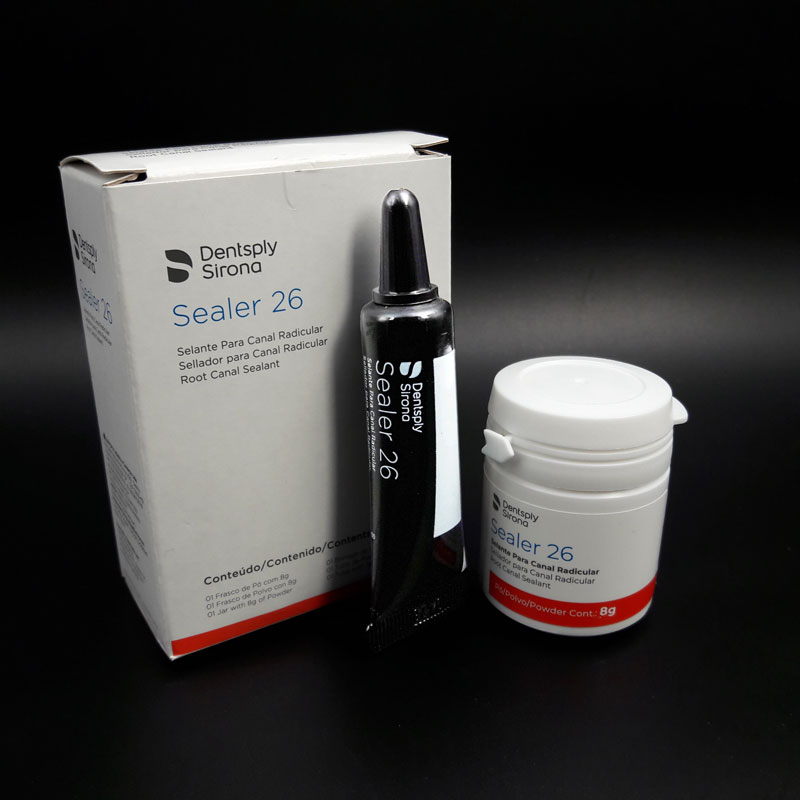
Sealer 26
Mixing:
It is recommended that Sealer 26 with Calcium Hydroxide be mixed on a thin glass slab. Using a suitable spatula, gradually incorporate the powder into the resin until a smooth, homogeneous mixture is obtained. The proper consistency is achieved when the mixture separates as it is lifted with the spatula to a height of 1.5–2.5 cm above the glass slab.
The average mixing ratio is approximately 2 to 3 parts powder to 1 part resin by volume.
Application:
After irrigation and thorough drying of the root canals, Sealer 26 with Calcium Hydroxide may be introduced into the canal using the operator’s preferred technique, such as with a Lentulo spiral, endodontic instruments, or with the aid of the master gutta-percha cone.
To reduce the viscosity of the cement and facilitate its placement inside the root canals, the glass slab may be gently warmed by holding it 10–15 cm away from a flame. This heating procedure may be repeated as many times as necessary.
Note: If hydrogen peroxide has been used as the irrigating solution, the canals must be irrigated again with sodium hypochlorite followed by physiological saline, and then completely dried before applying Sealer 26.
Clean the glass slab, spatula, and all other instruments immediately after use with alcohol, acetone, or chloroform.
If necessary, previous root canal fillings made with Sealer 26 can be removed with the aid of chloroform.
Increasing the powder-to-resin ratio improves the radiopacity of the material.
At body temperature, Sealer 26 polymerizes in approximately 12 hours. At room temperature (23 ± 2°C), polymerization occurs within 48 to 60 hours.

 علاقه مندیها
 سبد
۰
سبد
۰